PIN Communications Logo
  • Services
    • Elections: Local authority
      • BID Ballot
      • Canvass
      • Community Ballot & Elections
      • Council Tax
      • Electoral Print & Mail
      • Electoral Support Products
    • Elections: Membership & Full-Service
      • AGM Voting
      • Electronic Voting
      • Handheld Voting
      • Proxy Voting
      • Voting & Election Services
      • Virtual AGM Platform
    • Secure Communications
      • Billing & Statements
      • Critical Communications
      • Postal Management
    • Marketing Activation
      • Creative Services
      • Direct Mail
      • Exhibitions & Events
      • Fulfilment & Logistics
      • Marketing Print
      • Point of Sale Print
      • Postal Management
      • Promotional Incentives
    • Digital Communications
      • Digital Campaign Delivery
      • Digital Channels
    • Digital Platforms
      • Hybrid Mail
      • Virtual AGM Platform
      • Voting Platform
  • Sectors
    • Public Sector
    • Private Sector
    • Membership Organisations
  • Resources
    • Client Stories
    • PIN Insights
  • About
    • Certifications
    • ESG & Sustainability
    • Our Heritage
    • Careers
  • Contact
Talk to Us
PIN Communications Logo
Services
Elections: Local authority

BID Ballot

Canvass

Community Ballot & Elections

Council Tax

Electoral Print & Mail

Electoral Support Products

Elections: Membership & Full-Service

AGM Voting

Electronic Voting

Handheld Voting

Proxy Voting

Voting & Election Services

Virtual AGM Platform

Secure Communications

Billing & Statements

Critical Communications

Postal Management

Marketing Activation

Creative Services

Direct Mail

Exhibitions & Events

Fulfilment & Logistics

Marketing Print

Point of Sale Print

Postal Management

Promotional Incentives

Digital Communications

Digital Campaign Delivery

Digital Channels

Digital Platforms

Hybrid Mail

Virtual AGM Platform

Voting Platform

Sectors

Public Sector

Private Sector

Membership Organisations

Resources

Client Stories

PIN Insights

About

Certifications

ESG & Sustainability

Our Heritage

Careers

Contact

  • Post man placing mail through a letterbox

    In-house vs hybrid mail – what’s the difference and which is best for you?

    31 Mar 2026

    by PIN Communications

    Outbound physical mail is a critical communications channel for businesses and organisations that must deliver regulatory, statutory, or operational correspondence.

    Common use cases include utility bills, invoices, account statements, payment reminders or overdue notices, tax documents or financial summaries, council tax letters, legal notifications, compliance letters, complaint correspondence and customer service letters.

    Whilst many organisations outsource these communications to specialist providers, in many cases, they are prepared and sent out in-house, which can be costly and a drain on resources. Rising postage prices, the cost of printing consumables, and other factors such as staff time, compliance requirements and the risk of errors contribute to operational strain.

    As businesses and organisations look to modernise their mailing processes to save time and money without sacrificing reliability or compliance, hybrid mail has never been more essential as a practical, scalable alternative to drive efficiencies and communication effectiveness.

    Explore how PIN Communication’s hybrid mail solution can streamline your communications and reduce operational overheads by visiting our hybrid mail service page.

    What is traditional in-house mail?

    Traditional in-house mail refers to communications produced and dispatched internally by a business or organisation. This typically involves staff printing documents on office printers, manually folding and inserting them into envelopes, franking or stamping them, and sending them via Royal Mail or a business post service.

    In-house mail does have its benefits, but they are outnumbered by limitations and risks.

    The benefits:

    • Full internal control over documents and processes.
    • Immediate printing without any third-party involvement.
    • Familiar workflows requiring minimal change management.

    Limitations and risks:

    • High operational costs – including paper, ink, printer purchase and maintenance, envelopes, and franking equipment.
    • Labour-sapping processes – requiring staff time for printing, folding, stuffing, and sorting.
    • Increased risk of errors – when staff are collating documents and stuffing envelopes manually.
    • Limited scalability – a potential problem during peak mailing periods.
    • Compliance and security concerns – especially if sensitive data is handled in an open office environment.

    In short, traditional in-house mail works – but it demands significant internal resources and increased costs to maintain it.
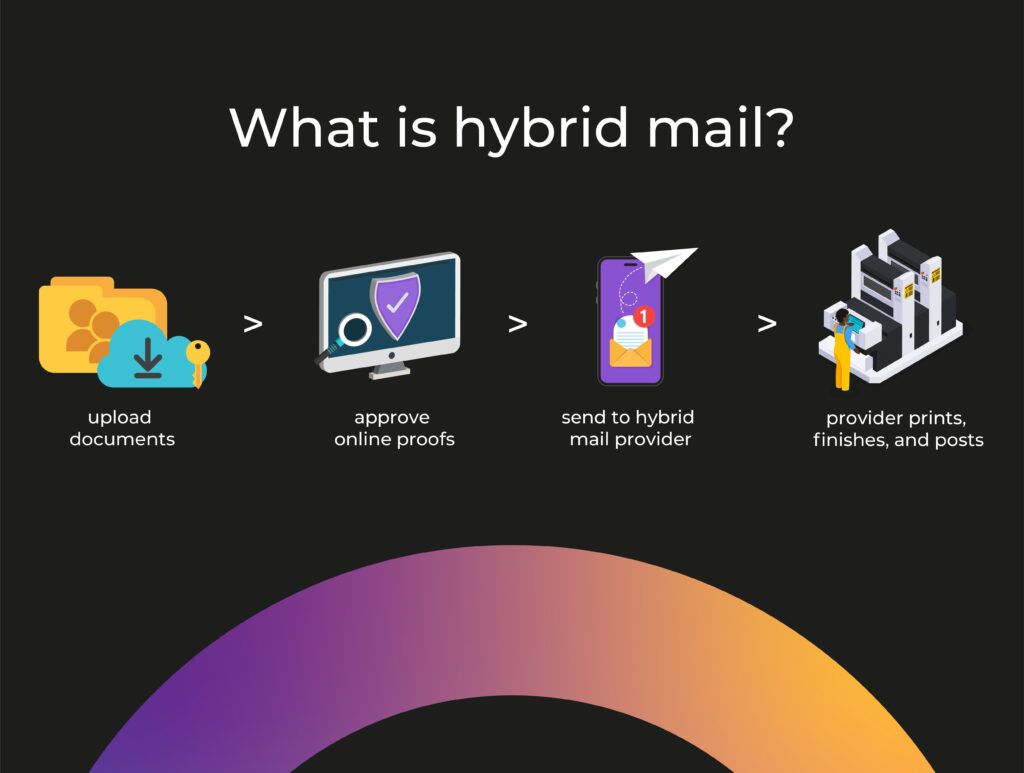
    what is hybrid mail graphic with iconography

    What is hybrid mail?

    Hybrid mail is a digital-to-physical mailing solution that is easy to install and simple to use. Instead of printing letters in-house, users simply upload their data to the secure hybrid mail platform, select their templates, review the platform generated proofs and then select them for print. The correspondence is then received by their hybrid mail provider, who prints, finishes, and posts the mail within their secure production environment.

    A light touch, flexible solution via either web portal or a print driver, hybrid mail can be used for either a handful of letters or up to thousands of letters and mail packs.

    Other benefits of hybrid mail:

    • Postal discounting, reduced consumable costs and high-volume print rates for bulk mailings.
    • High quality print and fully automated enclosing lines operate with 100% mailing integrity.
    • Minimal internal workload – no manual folding or stuffing.
    • Reduced risk of errors and data mismatch.
    • Instant on screen proofing.
    • Enterprise-grade security.
    • Template control and conditional logic to enforce branding and compliance rules.
    • Available as a web portal or simple print driver installation
    • No need to hold stationery stock or manage franking machines
    • Digital communication capability

    Hybrid mail solutions also works well alongside a digital communication strategy. The platform can be configured to allow for a digital first communication via email to drive further cost benefits, with any bounced or undelivered messages automatically reverting to physical printed mail. This ensures delivery of critical communications can be tracked in the first instance, while also reducing print and associated postage costs.

    Traditional Mail vs Hybrid Mail – what are the differences?

    Traditional MailHybrid mail
    CostHigh consumables, labour, postage equipment.Lower unit cost via bulk production and postal discounts.
    SpeedSlow, manual process.Automated production and dispatch with no limit on numbers.
    AccuracyRisk of human error stuffing envelopes.Automated processing reduces the risk of human error.
    ScalabilityLimited by staff and equipmentScales instantly to any volume of correspondence.
    SecurityOffice handling risks.Secure production environments.
    SustainabilityHigher risk of wastage.Efficient bulk printing along with digital offset options.

    Use cases for hybrid mail UK

    Local authorities, financial services, healthcare providers, utilities, membership organisations and call centres are among the broad range of hybrid mail users who rely on it for efficient, cost-effective and compliant document delivery.

    Hybrid mail is particularly valuable when communications must be:

    • Regulatory or statutory.
    • Trackable and provable.
    • High-volume or recurring.
    • Personalised via mail merge.
    • Sent within strict timeframes.

    When should organisations choose hybrid mail?

    Hybrid mail is designed for businesses and organisations of all sizes, from local authorities and public bodies to financial institutions, charities and membership organisations.

    It is ideal for any business or organisation producing communications internally, utilising consumables, internal printers and existing staff to manually enclose envelopes and mail them using a franking machine.

    By integrating secure production, templated communications, and flexible digital-to-print workflows, it enables teams to:

    • Reduce administrative workload.
    • Strengthen compliance controls.
    • Improve delivery reliability.
    • Lower mailing costs.
    • Maintain full audit trails.

    Conclusion

    Traditional in-house mail has served well for decades, but rising costs, manual processes, and compliance demands are making it harder to justify.

    Hybrid mail offers a modern alternative – combining the reliability of physical post with the efficiency of digital workflows and the benefits of a fully outsourced communication solution.

    For organisations sending anything from occasional letters to high-volume statutory communications, hybrid mail delivers measurable benefits in cost, speed, accuracy, and security.

    For information about PIN Communications and our hybrid mail solution visit our hybrid mail service page

    Why choose PIN Communications?

    Cost-effective – benefit from reduced consumable costs, high-volume print rates and postal discounting that could reduce postage costs by around 30%.

    Quality and consistency – create correspondence that consistently reflects your brand, and to a far higher quality than can be achieved on office printers. Automated enclosing lines operate with 100% mailing integrity eliminating errors that can occur when you have to hand enclose items into an envelope.

    Instant proofing and timely posting – instant on-screen proofing as soon as you upload your letters. Immediately you approve your job, it goes straight into a production queue. All 1st class mail submitted before 12noon is mailed the same day, while all 2nd Class post received by 5pm is mailed the following day.

    Easy installation – because our solution is lightweight to deploy, organisations can adopt it quickly without complex IT projects or infrastructure changes, using a print driver or secure web portal on laptop or desktop PCs. It can also be linked to existing document management systems using a built-in API.

    Multi-channel capability – choose between sending your communications via Email, SMS or as a physical mail pack, depending on the type of message you need to send and the channel preference of your customers.

    Safe and secure – data security policies and procedures are constantly reviewed and updated. All the data submitted to print is encrypted in transit and is held on secure, ISO27001 Cyber Essentials Plus certified live IT infrastructure.

    For information about PIN Communications and our hybrid mail solution visit our hybrid mail service page

    Stay informed about new developments at PIN Communications

    Be the first to hear about the latest developments at PIN Communications. Sign up for our newsletter and get the latest news sent straight to your inbox.

    Please enable JavaScript in your browser to complete this form.
    *
    Loading

    What we’ve been up to…

    • In-house vs hybrid mail – what’s the difference and which is best for you?
      PIN Insights

      In-house vs hybrid mail – what’s the difference and which is best for you?

      Compare in-house vs hybrid mail. Discover how hybrid mail reduces costs, improves accuracy,…

      Find out more

    • AGM voting: postal, online & hybrid
      PIN Insights

      AGM voting: postal, online & hybrid

      Discover how postal, online, and hybrid voting methods shape effective, transparent AGMs. From…

      Find out more

    • The Advantages & Disadvantages of Using the Single Transferable Vote (STV) System
      PIN Insights

      The Advantages & Disadvantages of Using the Single Transferable Vote (STV) System

      The Single Transferable Vote (STV) is a form of proportional representation voting system…

      Find out more

    • The Advantages and Disadvantages of Using the First Past-the-Post Voting System
      PIN Insights

      The Advantages and Disadvantages of Using the First Past-the-Post Voting System

      FPTP is clear, simple and decisive in the majority of cases, but many…

      Find out more

    • Trade Union Indicative or Consultation Ballot
      PIN Insights

      Trade Union Indicative or Consultation Ballot

      Before any industrial action or other significant trade union ballot, such as a…

      Find out more

    • Advantages and disadvantages of PR / Proportional Representation electoral system
      PIN Insights

      Advantages and disadvantages of PR / Proportional Representation electoral system

      Proportional Representation PR offers alternatives to first past the post and other majoritarian…

      Find out more

  • a conference room full of people

    The Advantages & Disadvantages of Using the Single Transferable Vote (STV) System

    1 Dec 2025

    by PIN Communications

    A guide to the Single Transferable Vote (STV) system

    The Single Transferable Vote (STV) is a proportional voting system where voters rank candidates in order of preference. This type of system is currently used for elections for deputy speakers in the House of Commons, Northern Ireland Assembly and local elections in Scotland and Northern Ireland.

    How does STV work?

    Voters using STV rank candidates in order of preference by marking one, two, three and so on. People can rank as many or as few candidates as they like. Each candidate needs to reach a set number of votes, called the quota, which is calculated based on the number of seats and votes cast.

    First, all the first-preference votes are counted, and any candidate who reaches the quota is elected. This system means candidates don’t need a majority to win, and more votes contribute to the outcome.

    Why does STV help reflect views of the electorate?

    Under STV, fewer votes are wasted, meaning most voters help elect a candidate they support. This can make representatives more accountable to the people who voted for them.

    In multi-member constituencies, parties may choose to put forward a balanced team of candidates in order to maximise the number of higher preferences that would go to their candidates. This goes some way to helping promote the advancement of women and ethnic-minority candidates, who are often overlooked in favour of a ‘safer’ looking candidate under ‘first past the post’.

    Elected bodies with broader representation are more likely to be both reflective of the electorate’s views and more responsive to them.

    In the 2022 Fife Council election, the SNP remained the largest party but still fell short of a majority, with Labour and Lib Dems holding significant seats too, illustrating how STV results in more balanced representation than winner-takes-all systems. Similar patterns were seen in Aberdeen City, Falkirk and Shetland Islands council elections, all held under STV in 2022, where councils ended up with mixed party make-ups and often no overall majority.

    Parties are broad coalitions and can be markedly split on certain key issues. With only one party person per constituency, the representatives elected may not share the views of their electorate.

    Single Transferable Voting System

    What are the other advantages of an STV voting system?

    STV also gives voters more than one representative to approach after the election, increasing choice and encouraging elected officials to provide a better service to their constituents. There are no safe seats under STV, meaning candidates can’t be complacent and parties must campaign everywhere; not just in marginal seats.

    When voters can choose to rank candidates, the most disliked candidate can’t win, as they are unlikely to pick up second, third and lower-preference votes. By encouraging candidates to seek first, as well as lower-preference votes, the impact of negative campaigning is reduced.

    In the 2022 Scottish local elections, STV produced councils where no party had overwhelming majorities and candidates needed support beyond first preferences. This meant voters’ second and third preferences helped decide final outcomes, reducing the effect of purely negative campaigning and removing the need for tactical voting common under First Past the Post.

    Under STV there is a more sophisticated link between a constituency and its representative. Not only is there more incentive to campaign and work on a more personal and local level, but also, the constituencies are likely to be more sensible reflections of where community feeling lies.

    Single Transferable Vote

    The disadvantages of STV

    • In sparsely populated areas, like the Scottish Highlands, STV could lead to large multi-member constituencies. This was one of the reasons cited by the Arbuthnott Commission for not recommending STV beyond local wards.
    • The process of counting the results takes longer under STV, meaning that results cannot usually be declared on the same night as the vote takes place.
    • In the 2022 Northern Ireland Assembly election, votes were counted under the STV system and the count was not completed on the same day polling closed. While some first preferences were counted and seats declared by the afternoon of the first day, the full count continued. In some places, results were declared nearly two days after polling day although some of the blame of the slow speed was also attributed to Covid-19.
    • A voting system that allows voters to rank candidates can be prone to what has been termed ‘donkey voting’, where people appear to vote for candidates in the order they appear on the ballot.
    • Voters only tend to come into contact with candidates at election time, whereas people in the party know them much better. Some argue that a system that allows a political party to parachute its preferred candidates into safe seats is better than one that leaves the choice more in the hands of the voters.

    How does STV compare with hybrid or online voting?

    STV is a vote-counting system designed to create proportional representation, while hybrid and online voting are delivery mechanisms for how ballots are cast and processed. STV can be used with either paper-based elections, hybrid elections, or fully online voting platforms. 

    FAQs

    Where is STV implemented?

    STV is used in Northern Ireland and in local elections in Scotland, but it is also used in Malta, Australia (Senate), and parts of the US. STV elections are also used in a significant number of membership, charity, professional body organisations and NHS Trust elections in the UK.

    Why do some countries use STV instead of first-past-the-post?stead of first-past-the-post?

    Countries adopt STV to achieve more proportional results, reduce wasted votes, and give voters more meaningful choice. Unlike First Past the Post, STV elects representatives which may reflect a wider range of voter views.

    Does STV take longer to count than other voting systems?

    Yes! Counting is more complex because surplus and transferred votes must be calculated. Many regions use software to speed up the process.

    Can independent candidates do better under STV?

    Yes. Since voters can rank individuals without worrying about party vote-splitting, independents often have more opportunity to gain transfers and meet the quota.

    Single Transferable Voting

    How can voter turnout be increased?

    Whether it is member engagement, achieving more candidates for nomination, or achieving increased voter turnout via postal ballots or online voting, PIN Communications is a trusted election services provider that will strive to make your election a success, every time.

    For an independent assessment of your organisation’s electoral needs and impartial advice and guidance about the electoral system that best fits your requirements contact PIN.

    Taking a tailored approach to elections, ballots, polls, AGMs, referendums and consultations, our democratic voting services and experienced team deliver impartial and transparent contests.

    Voting - Single Transferable Vote
    Contact us today

    Contact us today by phone 0161 209 4800 or email contactus@pin-commmunications.com.

    Stay informed about new developments at PIN Communications

    Be the first to hear about the latest developments at PIN Communications. Sign up for our newsletter and get the latest news sent straight to your inbox.

    Please enable JavaScript in your browser to complete this form.
    *
    Loading

    What we’ve been up to…

    • In-house vs hybrid mail – what’s the difference and which is best for you?
      PIN Insights

      In-house vs hybrid mail – what’s the difference and which is best for you?

      Compare in-house vs hybrid mail. Discover how hybrid mail reduces costs, improves accuracy,…

      Find out more

    • AGM voting: postal, online & hybrid
      PIN Insights

      AGM voting: postal, online & hybrid

      Discover how postal, online, and hybrid voting methods shape effective, transparent AGMs. From…

      Find out more

    • The Advantages & Disadvantages of Using the Single Transferable Vote (STV) System
      PIN Insights

      The Advantages & Disadvantages of Using the Single Transferable Vote (STV) System

      The Single Transferable Vote (STV) is a form of proportional representation voting system…

      Find out more

    • The Advantages and Disadvantages of Using the First Past-the-Post Voting System
      PIN Insights

      The Advantages and Disadvantages of Using the First Past-the-Post Voting System

      FPTP is clear, simple and decisive in the majority of cases, but many…

      Find out more

    • Trade Union Indicative or Consultation Ballot
      PIN Insights

      Trade Union Indicative or Consultation Ballot

      Before any industrial action or other significant trade union ballot, such as a…

      Find out more

    • Advantages and disadvantages of PR / Proportional Representation electoral system
      PIN Insights

      Advantages and disadvantages of PR / Proportional Representation electoral system

      Proportional Representation PR offers alternatives to first past the post and other majoritarian…

      Find out more

  • First Past The Post Voting System

    The Advantages and Disadvantages of Using the First Past-the-Post Voting System

    17 Oct 2025

    by PIN Communications

    First past the post (FPTP), also known as simple majority voting, winner-takes-all voting, or plurality voting, is the most basic form of voting system.

    While FPTP is clear, simple and decisive in most cases, many would argue that it is anything but a representative voting system.

    FPTP can also be used in multi-member electoral contexts where voters are asked to vote for as many candidates as there are vacancies. Examples include local council elections, elections of foundation trust governors and membership organisations.

    In public elections, FPTP is the second most widely used voting system in the world, after Party-List PR. It is principally used in places that used to be British colonies.

    FPTP is currently used to elect members of the House of Commons in the UK, both chambers of the US Congress and the lower houses in Canada and India.

    The use of FPTP voting systems used to be more widespread, but many countries have now adopted other alternative voting systems.

    The advantages and benefits of a FPTP voting system

    • It’s simple to understand.
    • It doesn’t cost much to administer.
    • It’s is fairly quick to count the votes and work out who has won; meaning results can be declared relatively quickly after the polls close.
    • In a political environment, FPTP enables voters to clearly express a view on which party they think should form the next government.
    • FPTP is ideally suited to a two-party system and generally produces single-party governments, although the 2010 UK General Election, which resulted in a Conservative-Liberal Democrat coalition, was an obvious exception.
    • Single-party governments, by and large, don’t have to rely on support from other parties to pass legislation, though as the UK found, that is not always necessarily the case as the Conservative-LibDem coalition government (2010-2015) demonstrated.
    • Some would argue that FPTP voting systems encourage broad-church centrist policies and discourage extremist points of view.
    First Past The Post Icon

    Disadvantages and shortcomings of FPTP voting

    • Representatives can get elected with small amounts of public support, as the size of the winning margin is irrelevant: what matters is only that they get more votes than other candidates.
    • FPTP encourages tactical voting, as voters often vote not for the candidate they most prefer, but against the candidate they most dislike.
    • FPTP is regarded as wasteful, as votes cast in a constituency for losing candidates, or for the winning candidate above the level they need to win that seat, count for nothing.
    • FPTP can severely restrict voter choice. Parties are not homogenous and do not speak with one unified voice. Parties are more coalitions of many different viewpoints. If the preferred-party candidate in a constituency has views with which a voter doesn’t agree, he or she doesn’t have a means of expressing that at the ballot box.
    • Rather than allocating seats in line with actual support, FPTP rewards parties with what is often termed ‘lumpy’ support; that is, with just enough votes to win in each particular area. With smaller parties, this works in favour of those with centralised support.
    • With relatively small constituency sizes, the way boundaries are drawn can have important effects on the election result.
    • Having small constituencies often leads to a proliferation of safe seats, where the same party is all but guaranteed re-election at each election. This not only effectively disenfranchises a region’s voters, but it leads to these areas being ignored when it comes to framing policy.
    • If large areas of the country are effectively electoral deserts for any particular party, not only is the area ignored by that party, but also ambitious politicians from the area will have to move away from their locality if they aspire to have influence within their party.
    • Because FPTP restricts a constituency’s choice of candidates, the representation of minorities and women suffers, as the ‘safest’ looking candidate is the one most likely to be offered the chance to stand for election.
    • Although encouraging two-party politics can be advantageous, in a multi-party culture, third parties with significant support can often be greatly disadvantaged.

    The alternative to FPTP rejected by UK voters

    The Alternative Vote (AV) is a system where the voter has the chance to rank the candidates in order of preference. However, a referendum in 2011 saw UK voters reject the idea of replacing FTPT with the AV system.

    The AV system is used to elect chairs of most committees in the House of Commons, the Lord Speaker and by-elections for hereditary peers in the House of Lords, whereby the voter puts a 1 by their first-choice candidate, a 2 by their second choice, and so on, until they no longer wish to express any further preferences or run out of candidates.

    Candidates are elected outright if they gain more than half of the first preference votes. If not, the candidate who lost (the one with least first preferences) is eliminated and their votes are redistributed according to the second (or next available) preference marked on the ballot paper.

    This process continues until one candidate has half of the votes and is elected.

    Another system commonly used in the UK is the Additional Member System (AMS), which is used by:

    • The Scottish Parliament.
    • The Welsh Parliament.
    • The London Assembly, 25 elected members who hold the Mayor of London accountable, scrutinise policies, and investigate key issues like transport, housing, and crime. 

    Voters are given two votes on separate ballot papers – one for a constituency member and one for a party list.

    In Scotland and Wales list members are elected by region. In London there is a single London-wide list.

    Constituency votes are counted first and the members for each constituency are elected using FPTP.

    Additional members are then elected by counting the party list votes in each region. The number of members elected from the list is based on the percentage of the votes cast but also considers the number of constituency members already elected in the region.

    This is designed to make the result more proportional to the number of votes cast.

    Compare voting systems

    The Single Transferrable Vote (STV) system, a form of proportional representation (PR), is used to elect members of the Northern Ireland Assembly and in local elections in Northern Ireland and Scotland.

    You can read about the advantages and disadvantages of STV in our insight.

    Proportional representation (PR) is a term used to describe a range of electoral systems in which the distribution of seats corresponds closely with the proportion of the total votes cast for each party or individual candidate. 

    You can read about the advantages and disadvantages of PR in our insight.

    Election management services by PIN Communications

    Organising an election or ballot requires structured planning, procedural accuracy, and impartial management.

    PIN Communications is a leading provider of election services with a dedicated team of highly experienced professionals delivering elections, ballots, polls, referendums and AGMs for a huge range of clients in the private and public sectors.

    Both postal and online services can be provided as part of our ISO9001 and ISO27001 certifications. Contact us on 0161 209 4808 to discuss your needs.

    Contact us today

    FAQs

    Where is the first past-the-post system currently used?
    First past-the-post (FPTP) is used to elect Members of Parliament to the House of Commons in the United Kingdom. It is also used in national legislatures such as the United States Congress, as well as in Canada and India. The system remains most common in countries with historical ties to British parliamentary practice.

    What are the main criticisms of FPTP?
    Common criticisms include its lack of proportionality, the potential for ‘wasted’ votes, and the possibility that a candidate can win with a relatively small share of the overall vote. It may also disadvantage smaller parties and encourage tactical voting, where voters select a candidate strategically rather than based solely on preference.

    What is the difference between FPTP and the Alternative Vote (AV) systems?
    Under FPTP, voters choose one candidate and the highest vote-getter wins. Under the Alternative Vote system, voters rank candidates in order of preference. If no candidate achieves more than 50% of first-preference votes, lower-ranked candidates are eliminated and votes redistributed until one candidate secures a majority.

    How does the Additional Member System (AMS) improve proportionality?
    The Additional Member System combines constituency representatives elected by FPTP with additional representatives selected from party lists. Voters cast two ballots – one for a constituency candidate and one for a political party. The list seats are allocated to better reflect overall vote share, helping to produce a more proportional outcome than FPTP alone.

    What is meant by a ‘safe seat’ under FPTP?
    A ‘safe seat’ refers to a constituency where one political party consistently wins by a significant margin, making it unlikely that another party will gain the seat at an election. In such areas, electoral competition may be reduced, and voters who support other parties may feel their vote has limited impact on the overall result.

    Election Management Services By PIN Communications

    No matter the size of your organisation, holding an election or vote is a major task. At PIN Communications, our election services to deliver impartial and transparent elections, ballots, polls, referendums and AGMs. We are an experienced election services provider, with a dedicated team of election professionals delivering elections and AGMs daily. Both postal and online services can be provided as part of our ISO9001 and ISO27001 certifications. Contact us on 0161 209 4808 to discuss your needs.

    Stay informed about new developments at PIN Communications

    Be the first to hear about the latest developments at PIN Communications. Sign up for our newsletter and get the latest news sent straight to your inbox.

    Please enable JavaScript in your browser to complete this form.
    *
    Loading

    What we’ve been up to…

    • In-house vs hybrid mail – what’s the difference and which is best for you?
      PIN Insights

      In-house vs hybrid mail – what’s the difference and which is best for you?

      Compare in-house vs hybrid mail. Discover how hybrid mail reduces costs, improves accuracy,…

      Find out more

    • AGM voting: postal, online & hybrid
      PIN Insights

      AGM voting: postal, online & hybrid

      Discover how postal, online, and hybrid voting methods shape effective, transparent AGMs. From…

      Find out more

    • The Advantages & Disadvantages of Using the Single Transferable Vote (STV) System
      PIN Insights

      The Advantages & Disadvantages of Using the Single Transferable Vote (STV) System

      The Single Transferable Vote (STV) is a form of proportional representation voting system…

      Find out more

    • The Advantages and Disadvantages of Using the First Past-the-Post Voting System
      PIN Insights

      The Advantages and Disadvantages of Using the First Past-the-Post Voting System

      FPTP is clear, simple and decisive in the majority of cases, but many…

      Find out more

    • Trade Union Indicative or Consultation Ballot
      PIN Insights

      Trade Union Indicative or Consultation Ballot

      Before any industrial action or other significant trade union ballot, such as a…

      Find out more

    • Advantages and disadvantages of PR / Proportional Representation electoral system
      PIN Insights

      Advantages and disadvantages of PR / Proportional Representation electoral system

      Proportional Representation PR offers alternatives to first past the post and other majoritarian…

      Find out more

  • Proportional Representation

    Advantages and disadvantages of PR / Proportional Representation electoral system

    17 Oct 2025

    by PIN Communications

    Proportional Representation: The advantages and disadvantages of this electoral system

    Proportional representation (PR) is a family of voting systems designed where the distribution of seats corresponds closely with the proportion of the total votes cast for each party or individual candidate. Instead of one group sweeping most of the representation with only a portion of the vote, PR aims to reflect voters’ preferences more fairly across the results.

    PR systems are used as alternatives to First Past the Post and other winner-takes-all methods, which often favour larger parties and can leave smaller groups without a voice. With PR, smaller parties have a better chance of gaining seats, giving voters a wider range of views represented in elected bodies.

    Proportional Representation

    Different forms of Proportional Representation

    There are many different forms of proportional representation. Some are focused solely on achieving the proportional representation of different political parties (such as list PR) while others permit the voter to choose between individual candidates (such as STV-PR). The degree of proportionality also varies; it is determined by factors such as the precise formula used to allocate seats, the number of seats in each constituency or in the elected body as a whole, and the level of any minimum threshold for election. Common PR systems include Single Transferable Vote (STV), Additional Member System (AMS), and list proportional representation, each with different ways of translating votes into seats.

    These approaches are used as alternatives to First Past the Post and other winner-takes-all approaches, which often benefit larger parties and can leave smaller groups under-represented. With PR, smaller parties have a more realistic chance of winning seats, helping to create elected bodies that include a broader range of political views.

    Proportional Representation

    What are the advantages of a PR electoral system?

    • Moving to proportional representation (PR) in the UK may offer minority parties and independent candidates a better chance of winning seats in Parliament.
    • The current First Past the Post electoral system is considered unrepresentative, as candidates can be elected with a very small share of the votes while all other votes cast in the constituency are wasted.
    • In the 2024 UK general election, Terry Jermy was elected MP for South West Norfolk with just 26.7% of the vote… one of the lowest winning vote shares in that election. This means nearly three‑quarters of voters in the constituency cast their ballots for other candidates, but those votes had no impact on who became the MP.
    • In fact, several MPs won their seats with well under 30% of the vote. Therefore, a large majority of voters in those constituencies preferred other candidates but weren’t represented by their choice. In East Londonderry and North Antrim, winners also took their seats with less than 29% of the vote.
    • PR ensures that the parties would have to appeal to their core supporters, rather than a small number of ‘swing voters’ in marginal seats. It could be argued that PR delivers fairer treatment of minority parties and independent candidates.
    • Under PR you could say that fewer votes are ‘wasted’ as more people’s preferences are taken into account, therefore offering greater and perhaps more-representative choice for voters.
    • In a City of Edinburgh Council by-election last June, voters ranked candidates under Single Transferable Vote (STV) – a proportional system also used in Scottish local elections. These were the first-reference shares:
      Labour – 20.8%
      Liberal Democrats – 20.4%
      Green – 18.2%
      SNP – 14.5%
      Conservative – 13.8%
      Reform UK – 7.9%

    PR rarely produces an absolute majority for one party, however, it could be argued that PR ensures greater continuity of government and requires greater consensus in policy-making.

    In the example above, no single candidate had close to a majority of first‑choice votes. Under First Past the Post, Labour would have won with only 20.8%, meaning nearly 80% of voters didn’t help elect the winner.

    Disadvantages of using a PR system

    • Under First Past the Post, MPs serve the constituency they campaign in. This makes them more inclined to tackle important local issues. As MP for Richmond, Rishi Sunak has repeatedly focused on local transport and infrastructure concerns including campaigning for improvements to local rail services including better road links. As he represents one specific constituency under First Past the Post, he regularly takes up community issues with national government departments.
    • PR can potentially provide a route for extremists to force their way into the political mainstream: under a FPTP electoral system this would be unlikely to happen. 
    • Under Sweden’s proportional representation system, the Sweden Democrats – a party with anti‑immigration roots – grew from no seats into one of the largest parties in the Swedish Riksdag after crossing the electoral threshold. In the 2022 Swedish general election, the Sweden Democrats won around 20.5 % of the vote and became the second‑largest party, and have since supported governing coalitions, giving them direct influence in national politics.
    • Some would say that PR produces ‘weak’ coalition governments rather than ‘strong’ majority governments, which arguably can lead to indecision, compromise and even legislative paralysis.
    • PR can also reduce accountability to voters, as an ousted party of government can retain office by finding new coalition partners after an election.
    • Under Ireland’s proportional representation with Single Transferable Vote (STV) system, neither major party won a majority in the 2024 general election. Instead, Fianna Fáil and Fine Gael, which had both been governing together in coalition before the election, ended up negotiating again after the vote to form a new coalition government. Micheál Martin became prime minister last January 2025, backed by a coalition of Gael and several independents, and will rule for the first three years of the five-year government, with Simon Harris of Gael taking over in November 2027. This meant that the incumbent camp effectively retained power rather than being replaced by a single opposition party with more support.
    • Another disadvantage is that PR list systems could possibly weaken the link between the elected representative and their constituency. The greater complexity and choice that PR allows can put voters off voting, by requiring them to have a greater knowledge of individual and party positions.
    PR Proportional Representation

    FAQs

    Where is proportional representation used in the UK?

    In the UK, Proportional Representation is not used for general elections, which still use First Past the Post. Scotland uses AMS for its Parliament and STV for local council elections, allowing voters to rank candidates and balance representation. Wales uses AMS for the Senedd, while Northern Ireland Assembly elections use STV. The London Assembly combines FPTP constituency seats with proportional list seats. These systems help smaller parties and voter preferences gain fairer representation compared with FPTP.

    Does PR make governments more likely to form coalitions?

    Yes! While this can encourage compromise, it can also slow decision-making and reduce clear mandates.

    Would PR benefit small parties in the UK?

    It would! PR allocates seats roughly in proportion to the total votes a party receives, rather than requiring them to win individual constituencies outright. This means smaller parties might win more seats and gain representation that reflects their actual support. Under First Past the Post a party with significant national support can win few or no seats if its votes are thin across constituencies. It could be argued that PR would make elections fairer and give voters a wider choice.

    Why hasn’t the UK adopted PR for parliament?

    The UK uses First Past the Post mainly due to tradition and simplicity. It produces clear winners and strong local representation, and larger parties that benefit from FPTP have resisted change. Past reform attempts, like the 2011 Alternative Vote referendum, failed, showing limited public support for PR.


    How could an organisation’s electoral needs be guided?

    For an independent assessment of your organisation’s electoral needs and impartial advice and guidance about the electoral system that best fits your requirements speak to PIN Communications.

    Contact us today

    Contact us today by phone 0161 209 4800 or email contactus@pin-commmunications.com.

    Stay informed about new developments at PIN Communications

    Be the first to hear about the latest developments at PIN Communications. Sign up for our newsletter and get the latest news sent straight to your inbox.

    Please enable JavaScript in your browser to complete this form.
    *
    Loading

    What we’ve been up to…

    • In-house vs hybrid mail – what’s the difference and which is best for you?
      PIN Insights

      In-house vs hybrid mail – what’s the difference and which is best for you?

      Compare in-house vs hybrid mail. Discover how hybrid mail reduces costs, improves accuracy,…

      Find out more

    • AGM voting: postal, online & hybrid
      PIN Insights

      AGM voting: postal, online & hybrid

      Discover how postal, online, and hybrid voting methods shape effective, transparent AGMs. From…

      Find out more

    • The Advantages & Disadvantages of Using the Single Transferable Vote (STV) System
      PIN Insights

      The Advantages & Disadvantages of Using the Single Transferable Vote (STV) System

      The Single Transferable Vote (STV) is a form of proportional representation voting system…

      Find out more

    • The Advantages and Disadvantages of Using the First Past-the-Post Voting System
      PIN Insights

      The Advantages and Disadvantages of Using the First Past-the-Post Voting System

      FPTP is clear, simple and decisive in the majority of cases, but many…

      Find out more

    • Trade Union Indicative or Consultation Ballot
      PIN Insights

      Trade Union Indicative or Consultation Ballot

      Before any industrial action or other significant trade union ballot, such as a…

      Find out more

    • Advantages and disadvantages of PR / Proportional Representation electoral system
      PIN Insights

      Advantages and disadvantages of PR / Proportional Representation electoral system

      Proportional Representation PR offers alternatives to first past the post and other majoritarian…

      Find out more

  • Warrington Town Hall

    Warrington Borough Council

    BID2 BALLOT – Empowering Town Centre Transformation with PIN Communications.

    The Client:

    Warrington Borough Council is the local authority for the Borough of Warrington.

    Warrington BID, is a partnership between the businesses in Warrington Town Centre across private, public, and voluntary sectors, working with Warrington Borough Council and other key organisations including Cheshire Police, and Warrington and Co.

    The Project/Challenge:

    As a result of the original BID ballot, the Warrington BID team has worked to a business agenda and delivered a programme of investments to help make the town centre a more attractive and safer place to visit. It organises and promotes events and markets the town centre as a destination of choice for shoppers and visitors.

    The objective of BID2 was to gain approval from 377 town centre businesses, for a further £1.5m private sector led investment for a 5-year period, also aiming to achieve more support in favour than the previous BID Ballot. So, Warrington Borough Council and Groundwork Cheshire, Lancashire and Merseyside (CLM) partnered with PIN Communications, to conduct the BID ballot. Warrington Borough Council were already accustomed to our unrivalled customer service and processes as they were an existing elections customer of our brand Print Image Network Ltd (now PIN Communications).

    Solution:

    ​PIN Communications worked with Warrington Borough Council and Groundwork CLM to prepare the BID information and ballot packs, which were posted to 377 hereditaments across Warrington.

    PIN Communications printed and mailed the notice of ballot letter and the ballot pack. A full reporting system was available to the council and Groundwork CLM twice a week during the voting period, with PIN Communications providing a result service to inform the team which hereditaments had voted to allow follow up activity. The count was also undertaken by PIN Communications and announced to the Project Officer Growth Directorate at Warrington Borough Council.

    “Outstanding result. Fantastic for the town centre, and a credit to all involved.”

    – Steve Park, Director of Growth, Warrington Borough Council

     “Thank you for all your support with the Warrington BID2 ballot, BID ballots are never easy and you have helped to support the process.”

    – Jane Hough, Deputy Director for Business Improvement Districts Business Services, Groundwork Cheshire, Lancashire & Merseyside

    Results

    A majority 80% in favour by number and 86% by rateable value, which secured the £1.5 million private sector led investment into the town centre for the next 5 years. There was an increase in support from 68% when the ballot was held for the town centre’s first BID 5 years earlier.

    There were 37% fewer no votes received in comparison to the previous BID, with a similar turnout of 38%.

    100% of respondents….

    • Would give a recommendation.
    • Said they would use our services again.
    • Said we were an improvement or the same as other suppliers.
    • Overall impression of customer experience.
    • Scored 100% for their project management support.

    Stay informed about new developments at PIN Communications

    Be the first to hear about the latest developments at PIN Communications. Sign up for our newsletter and get the latest news sent straight to your inbox.

    Please enable JavaScript in your browser to complete this form.
    *
    Loading

    Trusted partnerships. Real results.

    When you partner with PIN Communications, the proof is in the pudding with our results. Our business strives to deliver nothing short of exceptional results.

    • Cornish Mutual
      Client Stories

      Cornish Mutual

      Cornish Mutual Engage PIN Communications to handle AGM proxy voting with a provision…

      Find out more

    • The Chartered College of Teaching
      Client Stories

      The Chartered College of Teaching

      Independent Scrutineer, PIN Communication, administered paperless elections for The Chartered College of Teaching,…

      Find out more

    • Pharmacists’ Defence Association Union
      Client Stories

      Pharmacists’ Defence Association Union

      The PDA used e-democracy with PIN to elect regional representatives. The union opted…

      Find out more

    • Exeter Friendly Society
      Client Stories

      Exeter Friendly Society

      Independent scrutineer PIN Communications provides hybrid AGM voting solutions for The Exeter, including…

      Find out more

    • Nationwide Pension Fund
      Client Stories

      Nationwide Pension Fund

      PIN Communications administers member nominated Trustee Director election for Nationwide Pension Fund

      Find out more

    • Warrington Borough Council
      Client Stories

      Warrington Borough Council

      Warrington Borough Council partnered with PIN Communication to conduct the BID ballot.

      Find out more

PIN Communications Logo

A trading division of Print Image Network Ltd.
Registered Company No. 04009079


Head Office:

Pin Communications, The Tannery, Water Street, Stockport, SK1 2BP 

COMPANY

  • About
  • ESG and Sustainability
  • Certifications
  • Careers

QUICK LINKS

  • Services
  • Sectors
  • Client Stories
  • PIN Insights

GET IN TOUCH

  • Register as a Supplier Partner
  • Contact Us

LEGAL

  • Cookie Policy
  • Privacy Policy
  • Terms & Conditions
  • Accessibility

Copyright© 2025, Site designed and built by Cornerstone DM.