
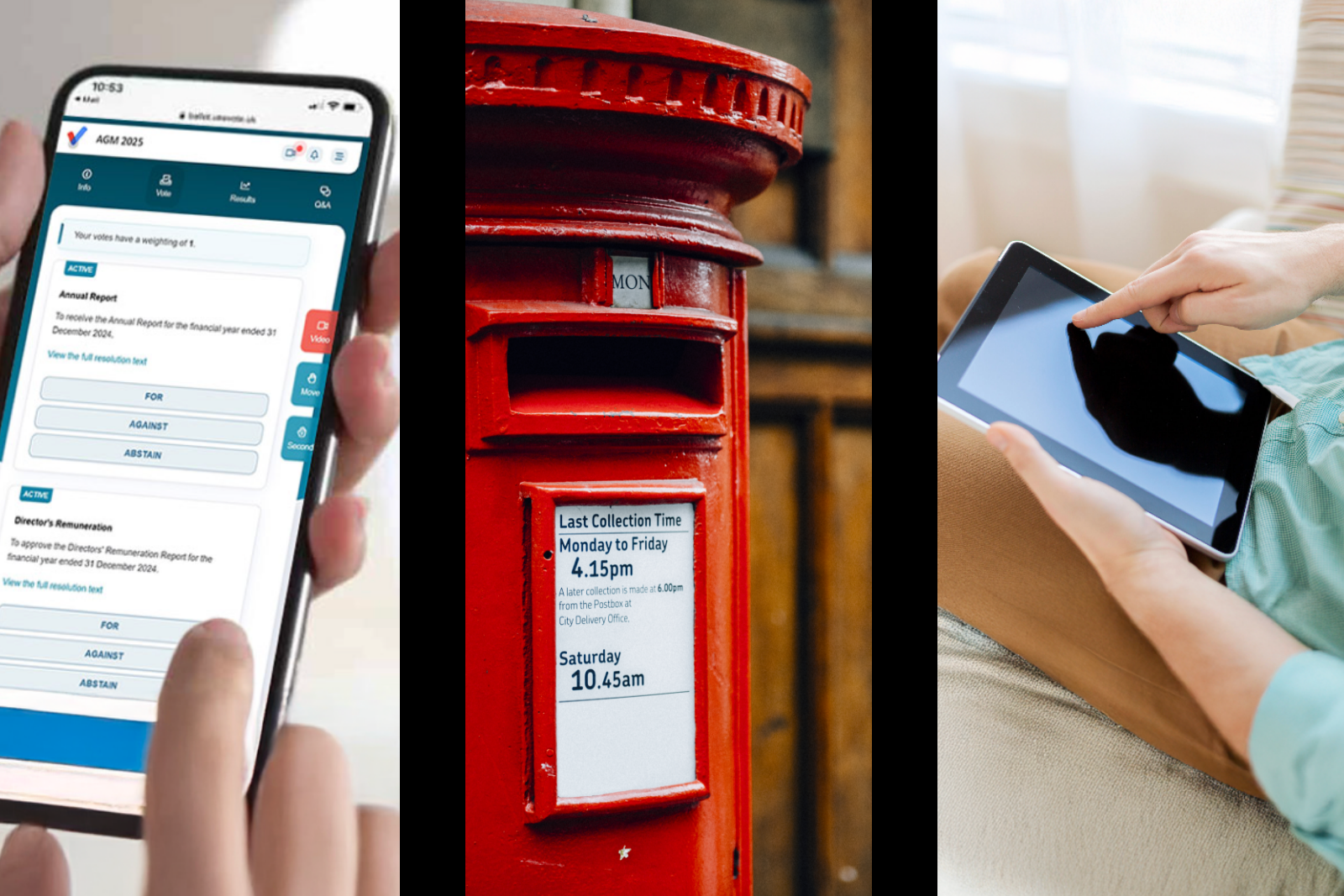
A guide to postal, online and hybrid AGM voting
Annual General Meetings (AGMs) are a cornerstone of good governance for membership organisations such as building societies, clubs, charities and professional bodies.
They ensure transparency and accountability and give members the opportunity to scrutinise their organisation’s performance, approve or challenge financial results and vote on key decisions.
Votes can be cast, collected and counted via various methods – postal or online during proxy voting or in person at the meeting using voting pads, paper or their own mobile devices, which are often seen as interchangeable, yet each has a vital role to play in allowing organisations to choose the right approach for their members.
Election services specialist, PIN Communications is a leading provider of AGM voting services to organisations with members, administering transparent and impartial solutions and delivering legislative knowledge, expertise and award-winning customer service. Our experience in delivering virtual, hybrid and in-person AGM voting services, plus postal and online proxy voting options, means we can find an AGM voting solution that works for you
Proxy voting – enabling representation
Proxy voting allows a member who cannot attend an AGM to appoint someone else – a proxy – to attend and vote on their behalf.
This is facilitated by sending the member a proxy ballot pack, either by post or online. They then appoint a proxy, for example, a fellow member who will be attending the meeting.
Before the AGM, the member can instruct their proxy exactly how to vote or leave some decisions to the proxy’s discretion.
Crucially, proxy votes are only counted if the proxy attends the meeting (either in person or online) – subject to each organisation’s articles of association. Proxy voting does not replace attendance – it enables representation.
What is a postal voting system?
Postal proxy voting allows members to receive, complete, and return paper ballots via mail. It is a long-established AGM method and remains popular with many organisations.
Postal packs commonly include annual reports and financial statements, proposed resolutions and supporting information, venue maps and agendas. They might also include QR codes or links that allow for the online submission of proxy votes, if articles allow.
They are highly visual and tactile and are easily accessed for members who are less digitally confident.
However, printed postal packs can be expensive when the cost of printing, collation, outbound and return postage and processing is considered. If postal packs are combined with an online system, to allow members flexibility in submitting their proxy votes, the cost of services may also increase.
Postal based processes can be slow too, with delivery and returns covering a number of weeks. Other drawbacks include voters forgetting to vote or missing deadlines.
The decision whether to use postal packs very much depends on the demographics of an organisation’s membership, the available data of membership information, tradition and the organisational expectations of the membership.
An alternative to send a full ballot pack and a more cost-effective solution is to send a single-page communication in the post to confirm voting eligibility which directs members to an online platform for documents and proxy voting.
This approach reduces printing significantly and eliminates the cost of return postage. It’s a useful middle ground and is becoming more common as organisations transition towards a digital approach.
Many organisations adopt a mixed approach due to the data available, sending postal packs to members without email addresses and digital communications to those with a verified email address.

What is an online voting system?
Online voting is undertaken via a digital platform that allows eligible voters to cast their ballots securely over the internet using a computer, tablet, or smartphone.
These systems are designed to streamline the voting process while maintaining accuracy, confidentiality, and compliance with governance requirements.
Where organisations hold reliable email data, proxy voting can be managed entirely online by sending members an email with:
Secure access to the AGM voting website where they can:
- Access all available documentation
- Have the ability to submit proxy votes online
- Submit questions ahead of the meeting
- Register their attendance (Virtually or In-Person)
This is an increasingly popular method of proxy voting as it’s significantly cheaper than the postal method, it enables faster delivery and provides the ability to track engagement, such as the email open rate, voting turnout and even the sending of reminders to vote.
Any perceived risks associated with online voting are mitigated through end-to-end encryption, multi-factor authentication and secure hosting that ensures integrity and transparency. However, organisations should consider if this method is suitable for members uncomfortable with digital tools and whether engagement might drop due to members expecting traditional, paper communications.

What is a hybrid voting system?
Not to be confused with a mix of postal and online voting, hybrid voting happens during the AGM itself.
It allows members attending the meeting in person, and those attending online, to vote at the same time on live resolutions.
How hybrid voting works:
- The meeting is live streamed via a secure link to those joining remotely with online voting opening and closing in real time.
- In-room voting takes place using the mechanism chosen by the organisation, such as paper ballots or authorised devices, etc.
- All votes are consolidated into a single count, with steps taken to ensure votes are not duplicated, such as someone submitting a physical ballot paper and also voting online.
Hybrid voting is not the same as proxy voting. Proxy voting happens before the meeting while hybrid voting happens during it.
Delivering a hybrid AGM
Hybrid elections require a reliable audio-visual feed, such as Microsoft Teams or Zoom, and secure integration with the voting platform. Some larger organisations opt for a ‘live broadcast’ provider with high production values, using broadcast-quality cameras, microphones and on-site crews. The live recording can then be repurposed into a long-term digital asset, published on the organisation’s website for transparency and member engagement.

Managing proxy and live meeting votes
AGMs can be complex affairs with members voting for themselves, or as a proxy for someone else, and attending either online or in person.
It demands a robust system whereby proxy instructions are preloaded ahead of the meeting, ensuring members only see the votes they are entitled to cast. The key to this is managing registrations and verifications to prevent the double-counting of physical and online votes we mentioned earlier.
From an AGM chair’s perspective, this complexity is invisible; they simply receive accurate, consolidated results
Articles of association – abiding by the rules
Every AGM is governed by the organisation’s Articles of Association – or equivalent rules – that define notice periods for meetings and voting, whether online voting is allowed and whether postal-only, online-only or a mix of both are allowed.
This means voting methods are often constrained not by preference, but by governance rules. Any AGM strategy should start with a review of the articles to see what is allowed.
Creating trust in the ballot process
As a leading provider of AGM voting systems for membership organisations, we are adept at administering transparent and impartial solutions – thus creating the key reason for using an independent provider such as PIN Communications: trust.
For example, if a client was to produce and distribute ballot papers themselves, the process could be open to challenge, especially where contentious resolutions are concerned.
An independent provider will:
• Manage member data securely.
• Produce and distribute ballot materials.
• Run the voting platform.
• Demonstrate neutrality if results are questioned by providing full audit trails.
Tailoring the approach for each individual client
There is no ‘one-size-fits-all’ AGM. The most effective AGM solutions are consultative, designed around an organisation’s needs, not what is easiest to deliver.
Cost and logistics vary in every case, based on member demographics, data quality, articles of association, meeting locations and timing (for example, a meeting on a Wednesday afternoon is likely to be cheaper than one on a Sunday), the expected attendance and level of production required.
Finding the right solution for your AGM
Postal, online and hybrid voting are not competing options – they are tools to facilitate a successful AGM.
Our role as an experienced AGM provider is to help organisations use the right combination of those tools to meet their legal obligations, control costs, and serve their members fairly.
AGMs work best when the process is transparent, independent and accessible – whatever format the meeting takes.
For an independent assessment of your organisation’s AGM needs and impartial advice and guidance about postal vs online voting, and the tools that best fit your requirements, contact PIN Communications.
Our tailored approach and experienced team have been at the heart of successful, transparent, and accessible AGMs for more than 15 years.
What we’ve been up to…
-

Delivered isn’t the same as remembered.
Discover how direct mail and digital channels can work together to create more…
-

In-house vs hybrid mail – what’s the difference and which is best for you?
Compare in-house vs hybrid mail. Discover how hybrid mail reduces costs, improves accuracy,…
-
AGM voting: postal, online & hybrid
Discover how postal, online, and hybrid voting methods shape effective, transparent AGMs. From…
-

The Advantages & Disadvantages of Using the Single Transferable Vote (STV) System
The Single Transferable Vote (STV) is a form of proportional representation voting system…
-

The Advantages and Disadvantages of Using the First Past-the-Post Voting System
FPTP is clear, simple and decisive in the majority of cases, but many…
-

Trade Union Indicative or Consultation Ballot
Before any industrial action or other significant trade union ballot, such as a…