

In-house vs hybrid mail – what’s the difference and which is best for you?
by PIN Communications
Outbound physical mail is a critical communications channel for businesses and organisations that must deliver regulatory, statutory, or operational correspondence.
Common use cases include utility bills, invoices, account statements, payment reminders or overdue notices, tax documents or financial summaries, council tax letters, legal notifications, compliance letters, complaint correspondence and customer service letters.
Whilst many organisations outsource these communications to specialist providers, in many cases, they are prepared and sent out in-house, which can be costly and a drain on resources. Rising postage prices, the cost of printing consumables, and other factors such as staff time, compliance requirements and the risk of errors contribute to operational strain.
As businesses and organisations look to modernise their mailing processes to save time and money without sacrificing reliability or compliance, hybrid mail has never been more essential as a practical, scalable alternative to drive efficiencies and communication effectiveness.
Explore how PIN Communication’s hybrid mail solution can streamline your communications and reduce operational overheads by visiting our hybrid mail service page.

What is traditional in-house mail?
Traditional in-house mail refers to communications produced and dispatched internally by a business or organisation. This typically involves staff printing documents on office printers, manually folding and inserting them into envelopes, franking or stamping them, and sending them via Royal Mail or a business post service.
In-house mail does have its benefits, but they are outnumbered by limitations and risks.
The benefits:
- Full internal control over documents and processes.
- Immediate printing without any third-party involvement.
- Familiar workflows requiring minimal change management.
Limitations and risks:
- High operational costs – including paper, ink, printer purchase and maintenance, envelopes, and franking equipment.
- Labour-sapping processes – requiring staff time for printing, folding, stuffing, and sorting.
- Increased risk of errors – when staff are collating documents and stuffing envelopes manually.
- Limited scalability – a potential problem during peak mailing periods.
- Compliance and security concerns – especially if sensitive data is handled in an open office environment.
In short, traditional in-house mail works – but it demands significant internal resources and increased costs to maintain it.
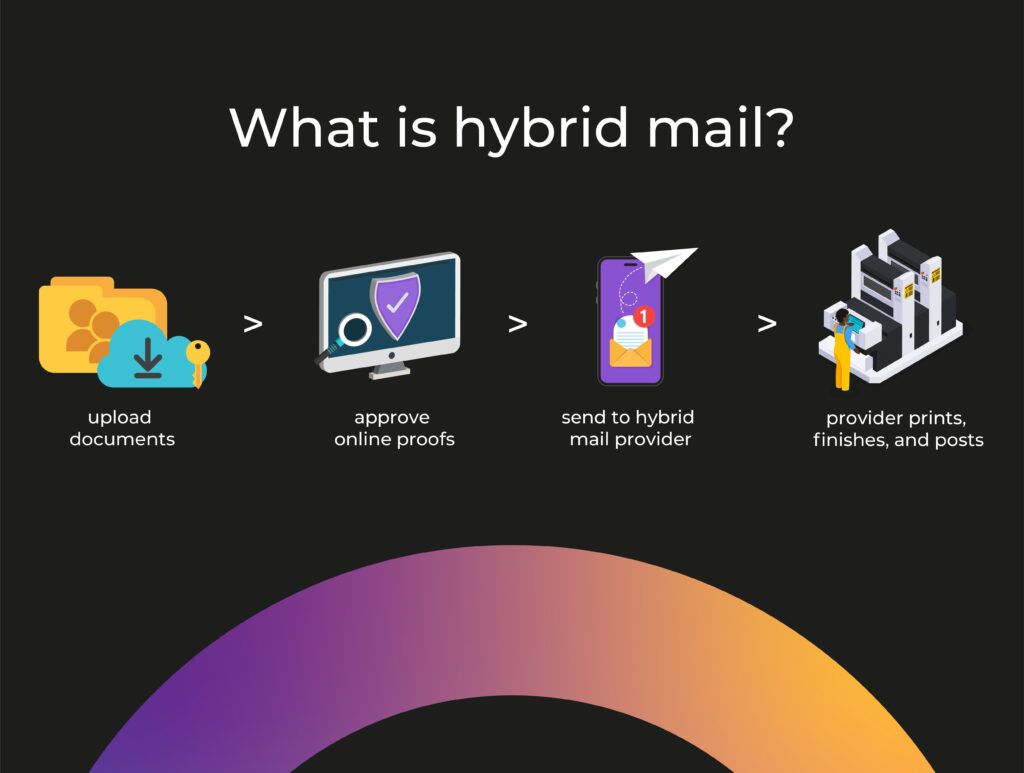
What is hybrid mail?
Hybrid mail is a digital-to-physical mailing solution that is easy to install and simple to use. Instead of printing letters in-house, users simply upload their data to the secure hybrid mail platform, select their templates, review the platform generated proofs and then select them for print. The correspondence is then received by their hybrid mail provider, who prints, finishes, and posts the mail within their secure production environment.
A light touch, flexible solution via either web portal or a print driver, hybrid mail can be used for either a handful of letters or up to thousands of letters and mail packs.
Other benefits of hybrid mail:
- Postal discounting, reduced consumable costs and high-volume print rates for bulk mailings.
- High quality print and fully automated enclosing lines operate with 100% mailing integrity.
- Minimal internal workload – no manual folding or stuffing.
- Reduced risk of errors and data mismatch.
- Instant on screen proofing.
- Enterprise-grade security.
- Template control and conditional logic to enforce branding and compliance rules.
- Available as a web portal or simple print driver installation
- No need to hold stationery stock or manage franking machines
- Digital communication capability
Hybrid mail solutions also works well alongside a digital communication strategy. The platform can be configured to allow for a digital first communication via email to drive further cost benefits, with any bounced or undelivered messages automatically reverting to physical printed mail. This ensures delivery of critical communications can be tracked in the first instance, while also reducing print and associated postage costs.
Traditional Mail vs Hybrid Mail – what are the differences?
| Traditional Mail | Hybrid mail | |
| Cost | High consumables, labour, postage equipment. | Lower unit cost via bulk production and postal discounts. |
| Speed | Slow, manual process. | Automated production and dispatch with no limit on numbers. |
| Accuracy | Risk of human error stuffing envelopes. | Automated processing reduces the risk of human error. |
| Scalability | Limited by staff and equipment | Scales instantly to any volume of correspondence. |
| Security | Office handling risks. | Secure production environments. |
| Sustainability | Higher risk of wastage. | Efficient bulk printing along with digital offset options. |
Use cases for hybrid mail UK
Local authorities, financial services, healthcare providers, utilities, membership organisations and call centres are among the broad range of hybrid mail users who rely on it for efficient, cost-effective and compliant document delivery.
Hybrid mail is particularly valuable when communications must be:
- Regulatory or statutory.
- Trackable and provable.
- High-volume or recurring.
- Personalised via mail merge.
- Sent within strict timeframes.
When should organisations choose hybrid mail?
Hybrid mail is designed for businesses and organisations of all sizes, from local authorities and public bodies to financial institutions, charities and membership organisations.
It is ideal for any business or organisation producing communications internally, utilising consumables, internal printers and existing staff to manually enclose envelopes and mail them using a franking machine.
By integrating secure production, templated communications, and flexible digital-to-print workflows, it enables teams to:
- Reduce administrative workload.
- Strengthen compliance controls.
- Improve delivery reliability.
- Lower mailing costs.
- Maintain full audit trails.
Conclusion
Traditional in-house mail has served well for decades, but rising costs, manual processes, and compliance demands are making it harder to justify.
Hybrid mail offers a modern alternative – combining the reliability of physical post with the efficiency of digital workflows and the benefits of a fully outsourced communication solution.
For organisations sending anything from occasional letters to high-volume statutory communications, hybrid mail delivers measurable benefits in cost, speed, accuracy, and security.
For information about PIN Communications and our hybrid mail solution visit our hybrid mail service page
Why choose PIN Communications?
Cost-effective – benefit from reduced consumable costs, high-volume print rates and postal discounting that could reduce postage costs by around 30%.
Quality and consistency – create correspondence that consistently reflects your brand, and to a far higher quality than can be achieved on office printers. Automated enclosing lines operate with 100% mailing integrity eliminating errors that can occur when you have to hand enclose items into an envelope.
Instant proofing and timely posting – instant on-screen proofing as soon as you upload your letters. Immediately you approve your job, it goes straight into a production queue. All 1st class mail submitted before 12noon is mailed the same day, while all 2nd Class post received by 5pm is mailed the following day.
Easy installation – because our solution is lightweight to deploy, organisations can adopt it quickly without complex IT projects or infrastructure changes, using a print driver or secure web portal on laptop or desktop PCs. It can also be linked to existing document management systems using a built-in API.
Multi-channel capability – choose between sending your communications via Email, SMS or as a physical mail pack, depending on the type of message you need to send and the channel preference of your customers.
Safe and secure – data security policies and procedures are constantly reviewed and updated. All the data submitted to print is encrypted in transit and is held on secure, ISO27001 Cyber Essentials Plus certified live IT infrastructure.
For information about PIN Communications and our hybrid mail solution visit our hybrid mail service page
What we’ve been up to…
-
In-house vs hybrid mail – what’s the difference and which is best for you?
Compare in-house vs hybrid mail. Discover how hybrid mail reduces costs, improves accuracy,…
-
AGM voting: postal, online & hybrid
Discover how postal, online, and hybrid voting methods shape effective, transparent AGMs. From…
-

The Advantages & Disadvantages of Using the Single Transferable Vote (STV) System
The Single Transferable Vote (STV) is a form of proportional representation voting system…
-

The Advantages and Disadvantages of Using the First Past-the-Post Voting System
FPTP is clear, simple and decisive in the majority of cases, but many…
-

Trade Union Indicative or Consultation Ballot
Before any industrial action or other significant trade union ballot, such as a…
-

Advantages and disadvantages of PR / Proportional Representation electoral system
Proportional Representation PR offers alternatives to first past the post and other majoritarian…